A new IIIT Hyderabad study reveals alarming temperature rise and oxygen
decline in the middle stretch of the Ganga. Here’s why Holy water sourced
from the Gangotri Valley remains untouched by this crisis.
PUBLISHED: June 23, 2026 CATEGORY: News & Research | Source Authenticity
New research warns of high pollution and rising temperatures in the mid-stream. Learn how to ensure you are buying 100% pure, certified Sacred Water.
A study by the Hydroclimatic Research Group (HRG) at the International
Institute of Information Technology (IIIT), Hyderabad, led by Dr. Rehana
Shaik, has documented a deeply troubling trend for the river.
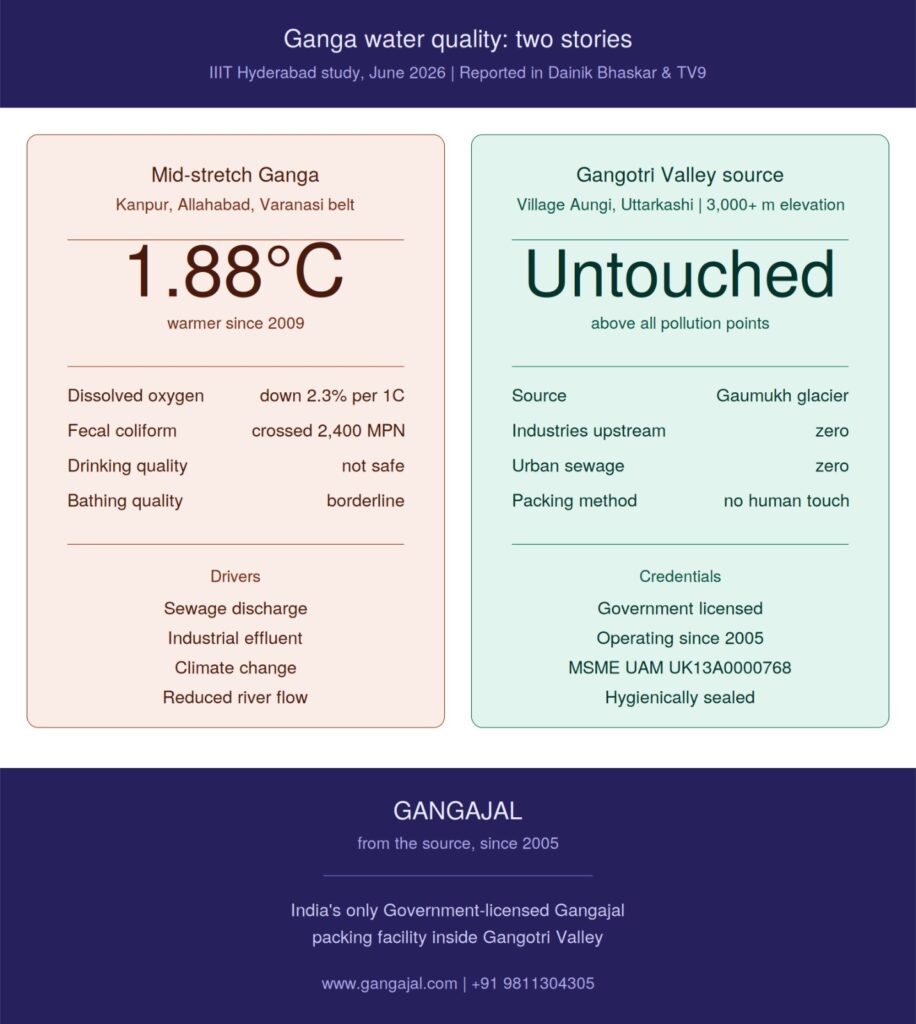
The annual mean temperature of the river’s mid-stretch has risen from
0.9°C to 1.88°C between 2009 and 2019, with the warming trend continuing
through 2025. For every 1°C rise in river water temperature, the
dissolved oxygen in the water drops by approximately 2.3%. In some
mid-stretch zones, fecal coliform readings have crossed 2,400 MPN/100 ml
— well above the bathing-quality limit of 2,500 — and the water is no
longer considered safe for drinking without heavy treatment.
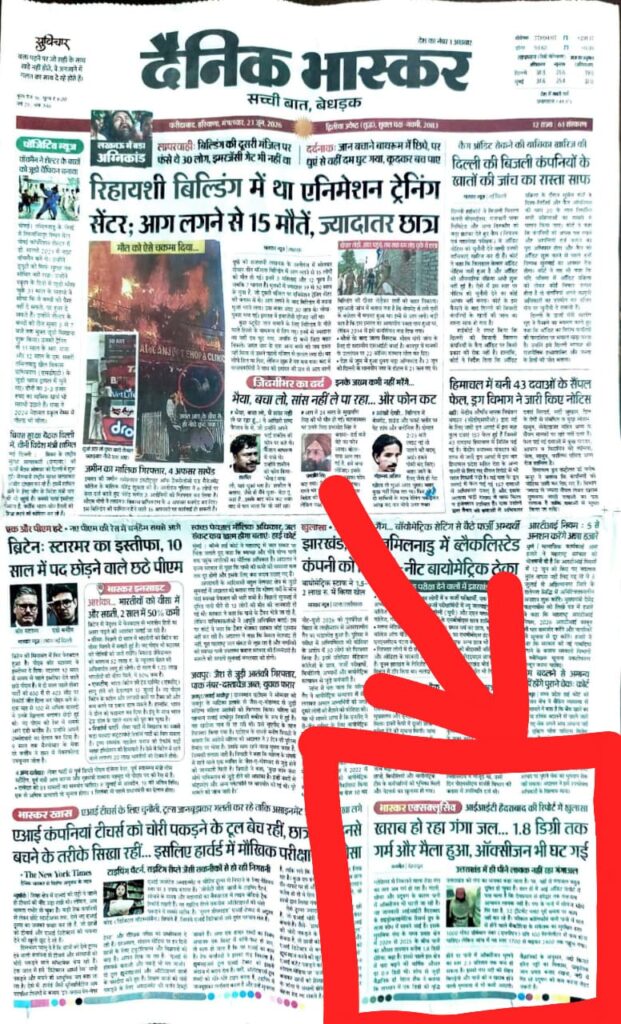
This research has been picked up by Dainik Bhaskar (Bhaskar Padtaal,
print edition, June 2026) and TV9 Bharatvarsh, raising fresh concerns
about the future of one of India’s most sacred rivers.
WHAT THE STUDY SAYS — IN SIMPLE TERMS
- The Holy River middle stretch (Kanpur, Allahabad, Varanasi belt) is
warming faster than ever recorded. - Warmer water holds less oxygen — threatening fish, aquatic life,
and water-dependent communities. - Pollution, reduced river flow, dams, and climate change are the
main drivers. - The researchers warn that without urgent action, the mid-Ganges could face year-round riverine heatwaves by 2090.
BUT THERE IS AN IMPORTANT DISTINCTION
The study focuses on the MIDDLE STRETCH of the The Holy River — the
industrialized belt that flows through Uttar Pradesh and beyond.
This is the zone where untreated sewage, tannery effluents,
chemical waste, and urban runoff have steadily degraded the river.
The SOURCE region — Gangotri Valley, high in the Uttarakhand
Himalayas — tells a completely different story.
At over 3,000 metres elevation, just below the Gaumukh glacier,
the Bhagirathi (the original River) emerges in its purest form.
There are no industries here. No urban sewage. No agricultural
runoff. Only snow-melt water filtered through ancient Himalayan
rock, fed by the natural mineral richness that has been revered
in Indian scriptures for thousands of years.
This is where our Holy water is sourced.
WHY GANGAJAL.COM IS DIFFERENT
Since 2005, Uttarkashi Minerals Corporation has operated the only
Government-licensed Sacred Water packing facility inside the Gangotri
Valley. Our facility is located at Village Aungi, P.O. Maneri, on
the Gangotri Road — directly on the upper reaches of the Bhagirathi,
far above any urban or industrial activity.
Every bottle of Holy water we pack carries:
- Water drawn directly from the original Gangotri Valley flow
- Hygienic, no-human-touch packing under licensed supervision
- Government authorization (MSME UAM No. UK13A0000768)
- Sacred purity that scientific reports cannot question because the
pollution they describe simply does not exist at our source.
WHAT THE BHASKAR REPORT MEANS FOR YOU
If you have ever wondered “is the Holy Water I am buying really pure?”
— the IIIT Hyderabad research gives you the answer in the negative for
ANY Holy water sourced from Haridwar downstream, Allahabad, Varanasi, or
the plains belt. Those waters are now scientifically documented as
warmer, less oxygenated, and increasingly contaminated.
The only Sacred water that escapes this crisis is the one sourced from the
Gangotri Valley itself — above the points of pollution, at the original
divine source.
That is the Sacred water we have been bottling for two decades.
REFERENCES & FURTHER READING
- IIIT Hyderabad — Hydroclimatic Research Group
https://fac-webpages.iiit.ac.in/hrg/ - Rajesh, M. & Rehana, S. (2022). “Impact of climate change on
river water temperature and dissolved oxygen: Indian riverine
thermal regimes.” Scientific Reports, 12, 9222.
https://www.nature.com/articles/s41598-022-12996-7 - Rehana & Rajesh (2023). “Assessment of impacts of climate change
on Indian riverine thermal regimes using hybrid deep learning
methods.” Water Resources Research.
https://agupubs.onlinelibrary.wiley.com/doi/full/10.1029/2021WR031347 - Mongabay India — “Riverine heatwaves are on the rise” (4 May 2026).
https://india.mongabay.com/2026/05/riverine-heatwaves-are-on-the-rise/ - TV9 Bharatvarsh — “तेजी से गर्म हो रहा गंगा का पानी,
16 साल में 1.88°C बढ़ गया तापमान” (19 June 2026).
https://www.tv9hindi.com/state/uttarakhand/ganga-river-water-is-warming-up-find-out-what-impact-will-be-know-full-deatils-3824920.html - Dainik Bhaskar — “Bhaskar Padtaal” feature on Holy water
quality, IIIT Hyderabad report (Print edition, June 2026).
Choose Holy water that comes from the source.
Choose the only Government-licensed Holy water from Gangotri Valley.
Choose purity that science still respects.
📞 +91 9811304305
🌐 www.gangajal.com
- June 23, 2026
- 216
- 0
- Uncategorized